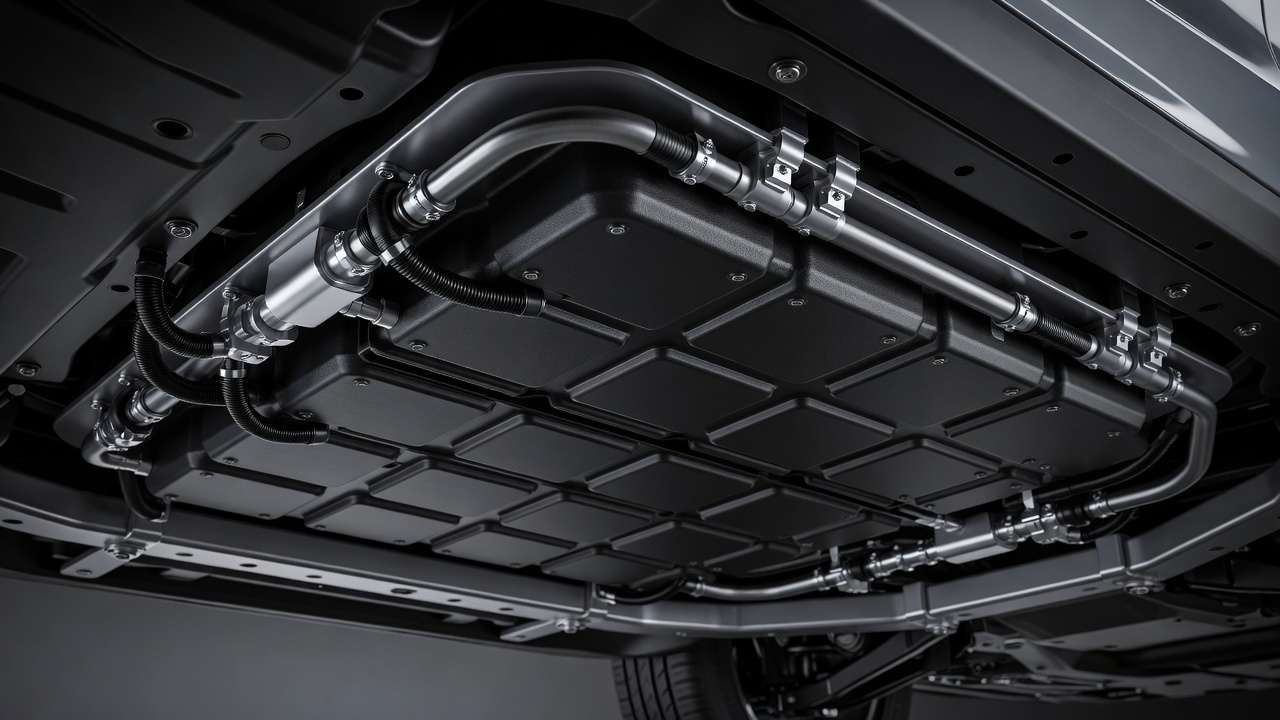
Distinguish capacity from access
Gross capacity describes a pack’s nominal total energy, while usable capacity refers to the energy made available for normal driving under the vehicle’s control strategy. Manufacturers may retain buffers at the top or bottom of the operating window. Published terms are not always consistent, so verify which figure appears in a comparison before calculating range.
A battery management system monitors and controls operation within permitted limits. The dashboard’s displayed 0% and 100% are therefore not necessarily the cells’ absolute electrochemical extremes. That does not mean it is sensible to run a vehicle until it stops. Leave enough reserve for weather, diversions and a charger that is unavailable when you arrive.
Use chemistry as context, not a winner’s badge
Lithium iron phosphate, usually shortened to LFP, and nickel-containing chemistries such as NMC and NCA are established lithium-ion approaches. LFP can offer advantages in material cost and cycle durability, while nickel-rich designs can offer higher energy density. These are broad tendencies, not guarantees for a complete vehicle. Pack construction and operating conditions can outweigh a simplified chemistry label.
Energy density matters because a given amount of stored energy affects mass and packaging. Yet the lightest pack is not automatically the most efficient car: aerodynamics, tyres, motors, cabin systems and vehicle size also influence consumption. Compare the finished vehicle’s usable energy and measured efficiency rather than assuming one chemistry must deliver better ownership economics.
| Topic | What to verify | Why it matters |
|---|---|---|
| LFP or nickel-containing cells | Exact variant and model year | Cell sourcing can differ within a model range |
| Usable capacity | Manufacturer definition | Determines accessible driving energy |
| Thermal management | Cooling, heating and preconditioning | Affects charging readiness and operation |
| Warranty | Time, mileage, capacity threshold and exclusions | Defines contractual support, not expected lifespan |
Temperature management changes the experience
A battery that is too cold may accept less charging power until it warms. A very hot pack may also need protective limits. Some vehicles can prepare the battery when navigating to a compatible fast charger, but support and activation differ. Check the manual and software version rather than assuming that entering any charging address triggers preparation.
Cabin preheating and battery preconditioning are related ownership conveniences but not the same function. A warm cabin does not prove that the cells are ready for maximum DC power. Similarly, the presence of a heat pump does not by itself establish a specific winter range improvement. Relevant tests must identify temperature, trip length and the equipment fitted to the tested car.
Understand ageing without predicting a date of failure
Battery ageing includes changes associated with time and use. Temperature exposure, charge level, cycling and the vehicle’s control strategy can influence degradation. Capacity loss is not necessarily linear, and a single universal annual percentage is a poor basis for judging every vehicle. Evidence from one fleet should not be presented as a warranty for another model.
Follow the manufacturer’s instructions for routine charge limits and storage. Some LFP-equipped vehicles have particular full-charge recommendations associated with operation or charge estimation; that does not make the same routine appropriate for every pack. Nor should general advice about avoiding high charge levels override the exact vehicle’s documented requirements. Prepare for a trip when needed, rather than treating a generic internet rule as engineering guidance.
Ask better questions about a used EV
Request the remaining battery warranty terms and confirm transferability, service requirements and any capacity-retention threshold. A warranty threshold defines a contractual remedy under specified conditions. It is not a promise that every pack will remain above a particular real-world range, and it should not be mistaken for a predicted replacement date.
A displayed range estimate depends on recent use and weather; it is not a battery-health certificate. Where available, obtain a documented diagnostic assessment with a clear method and date. Clarify whether the reported state of health is an estimate from onboard data or the result of a controlled capacity assessment. Review accident history, underbody condition, recalls and charging operation with a competent professional.
Keep emerging technology in proportion
Solid-state batteries, sodium-ion cells and revised pack architectures are legitimate areas of development. A laboratory result, pilot line announcement and widely supported production vehicle are different stages of readiness. Before treating a headline as a reason to delay a purchase, check commercial availability, warranty support, charging performance and whether the claimed benefit applies to a cell or a complete pack.
For most buyers, an available car that suits their journeys is more useful than an unspecified future breakthrough. Prioritise sufficient winter range, dependable charging, transparent warranty conditions and an ownership cost you can sustain. Never open or attempt to repair high-voltage equipment yourself; use appropriately qualified technicians.